A Mosaic of Human(?) Evolution: Australopithecus sediba's Challenges
The anthropology community has been filled with buzz recently about the discovery of a new species, Australopithecus sediba. Is it really an ancestor to modern-day humans? Does it have a human-like brain or an ape-like brain? What do its humanoid hands but ape-like feet mean for the evolution of walking? We may be arguing about these issues for a while, but the completeness of the skeleton and its distinctive blend of early and more modern humanoid features set it on par with Lucy (Australopithecus afarensis) in importance. In a field where many even critical discoveries revolve around no more than a piece of jaw or a corner of a hip bone, this is a prize opportunity to learn more about how we developed the features that set humans apart from chimps and gorillas. For the longest time, the world has known of Lucy, the star of the paleoanthropological world, as our ancestor from about 3 million years ago. Despite many interesting findings since her fateful discovery, either due to the lack of a fossil record from incomplete skeletons or theoretical arguments about our family tree, we haven’t been able to draw a clear timeline of what led from Lucy to the first Homo habilis, the “handyman” that led to our own (Homo) sapiens. This all changed when a dig in Africa produced four fossil skeletons of stunning completion. They are now known as Australopithecus sediba, dated to a little less than 2 million years ago. The star of the show so far has been MH1, a juvenile male with a skull so complete that scientists have constructed a virtual model of its brain.
How can we even know what kind of brain it had if all we get is bone? Scientists used a CT scan of the male skull to create a model of the interior of the cranium. This endocast is constructed from many X-ray scans, rotated 360-degrees around a central point, so that each scan is like a cross-sectional slice of the skull. By digitally modeling the combination of those slices, scientists can deduce what type of brain and therefore what mental capacity it had. Based on that, we can then try to predict whether it used tools, and even speculate on its social organization and its capacity for planning and self-awareness.
A. sediba’s brain challenges what we thought we understood about the evolution of childbirth, bipedalism, and tool use. Some scientists are even claiming that the four fossils aren’t a separate species at all. Anthropologists are arguing not just about where to place A. sediba in our family tree, but about old and established theories about human evolution that have dominated the field for decades.
A Challenge to Childbirth
We originally thought that it was our big brains that caused our pelvises to evolve the way they did. After all, one major constraint on brain size, and therefore head size, is childbirth. How could our enormous brains fit through our tiny pelvises? We compensated for that with severely delayed development: compared to other mammals, human babies are basically born premature. When sheep are born, they can stand up within minutes. For a human baby, that process can sometimes take twelve months. We grow our brains, and the rest of ourselves, outside the womb, whereas other mammals emerge nearly ready-made. As a result, the easiest explanation would be that our pelvis has also rotated and reshaped to accommodate the wider birth canal.
A. sediba has thrown a wrench into this theory, because it has a small head, but its pelvis is still rotated the way a Homo pelvis would be, and yet its narrowness still echoes of Lucy. If we look closely at A. sediba’s pelvis and skull, we find that while its pelvis is a blend of the rotated hominin pelvis and the narrower australopithecine pelvis, its brain measures only 420 cubic centimeters (cc). To put that into context, a modern human brain averages upwards of 1500 cc. Lucy (A. afarensis) had a brain of around 400 cc. A. sediba has a brain size comparable to that of a chimp, clocking in at less than 500 cc on average. This means that even though A. sediba shares the same brain volume as Lucy and chimpanzees, its pelvis (and the rest of it, as we shall later see) was already beginning to change. So if A. sediba didn’t have a big brain to reshape its pelvis, what did it have instead?
A Challenge to Bipedalism
The answer to that question lies outside of the cranium, and requires us to think about how bipedal A. sediba was compared to Lucy or to a modern human. One feature that sets us “above” our ancestors is our ability to rise up and move about on two legs alone. Humans are completely bipedal; for the most part, we do not suddenly decide to switch to all fours in the middle of a meeting, or swing from the pipes on a train platform because it’s easier than walking to the train. Chimpanzees primarily travel on all fours, and although they can occasionally walk around on their hind legs, knuckle walking is much easier for them than for us. Human and ape skeletal features have evolved to suit their nearly locomotion lifestyles, but we see something different when we look at fossils from the transition between the ape-like australopithecine and the modern human.
Bipedalism requires changes in the shoulder blade, the pelvis, the legs, and the feet. Even the neck and spine are involved in upright mobility. Although chimpanzees and humans might share a common ancestor and are not related in any direct line of descent, it’s still useful to compare the chimpanzee’s ape features with our own. Our arms are relatively short compared to our legs, but apes and australopithecines have long upper limbs, with large joints to handle the weight they share with the rear limbs. The thickness and strength of the arm, leg, and wrist bones adjust in humans and in chimps based on how much weight they habitually need to support. On a chimpanzee, the shoulder blade is completely rotated so it can swing between branches, and humans still retain some of that flexible shoulder joint. The thickness of the spinal vertebra and the orientation of the pelvis both shift to accommodate the suddenly vertical load that humans endure in order for us to lift our heads above the crowd of ape-like relatives.
When we take all these comparisons and apply them to Australopithecus sediba, it’s as if we had tripped along the way and tossed all these features together. The sides of A. sediba’s pelvis are more vertical like you would expect of Lucy, and the size is more like Lucy’s, but the shape and angle of the pelvis where it sits in the body is more like a human’s. It also has the strong, long arms of a chimpanzee or an australopithecine, and the large joints of someone used to supporting their weight on their arms. Parts of the hip, knee, and ankle look like they would be best for bipedalism, but the foot looks much more like an ape’s knuckle walking foot. Overall, there is a mix of tree-swinging, knuckle-walking australopithecine and a large, bipedal hominin, with each individual distinct feature creating a confusing bigger picture.
There is no change in brain size or head size that could explain the change in pelvis, but there are changes in the rest of the body that are related to a newfound reliance on bipedalism, rather than swinging from branch to branch or knuckle walking over the ground. These differences happen in an otherwise australopithecine body carrying an australopithecine-sized brain. The old theory of childbirth changing our pelvises may just be untrue, and A. sediba might be the perfect exception that disproves the rule. It might just be possible that bipedalism, and not babies with bigger brains, is the cause for the signature changes in our pelvis that mark the evolution from Australopithecus to Homo. Then again, as many scientists have pointed out, why can’t it be both? The jury’s still out and the papers are still being written.
A Challenge to Tool Use
If walking came before bigger brains, does that also mean it came before smarter brains? The precise origins of stone tools are murky, and even if we see evidence of tool use 3 million years ago, that still doesn’t tell us how we came up with the idea of creating knives or axes out of bits of boulders. Whether a stone broke into a chopping blade by accident, or a few australopithecines started pounding rocks together out of sheer boredom at night (a wonderful image from an old professor of mine), the invention of tools had profound changes on human ancestral physiology.
The stunning endocast created for A. sediba, combined with skeletal evidence from its hands, can tell us a great deal about the changes in brain capacity, diet, and maybe even social complexity as it developed towards human society.
We associate the brain’s frontal lobe with planning, thinking, emotions, and other higher functions. Your frontal lobe stops you from saying something rude, helps you decide not to steal, and recognizes that surprise from a practical joke isn’t a signal for your body to go into survival mode. Many scientists think that planning ahead is a very human thing, and specifically, planning several steps ahead with many other humans. Chimpanzees are known to get a bunch of friends together for precise attacks against other chimpanzees. Baby baboons will fake an injury to get more food. Other primates can be just as devious as we are, but no chimpanzee has ever led a concerted and sustained effort to conduct siege warfare or to coordinate a commodities trading market in bananas. The simplified answer is that they do not have the same frontal lobe organization that we do.
Compared to other australopiths, A. sediba’s brain isn’t remarkable except for its frontal lobes. Like the blend of australopith and hominin features we see in is skeleton, its brain is overall australopithecine, but its frontal lobes have the shadows of future humans to come. Why the change? Its australopithecine cousins also have bipedalism, but their brains don’t harbor these glimmerings of the future man to come. They’re also known for tool use, as early as 3 million years ago, but their brains don’t have this kind of neural reorganization.
We might be lost at this point, if not for A. sediba’s hands and teeth. Its hands don’t completely look like ours, and probably wasn’t as good with precision grip as we were. But remember that A. sediba’s hands were occasionally freed to do other things while it walked around bipedally. Its hands could grasp more than tree branches, at least, and we see that in its human-like thumb to finger proportions. It’s as if an almost-human hand was grafted onto an australopithecine arm.
Another hint comes to us in the form of the juvenile male’s molars. Inside its vertical, human-like face, second molars already developed. Their arrangement is australopithecine, but their size is closer to Homo. The simple supposition is that what A. sediba was eating had changed how large its teeth needed to be. If its diet changed, then the way it gathered or reached those foods had changed too. Bipedalism meant it could see higher in non-wooded areas, and the improved finger dexterity meant it might be in same tool-making tradition we share with the early makers of stone “shovels.”
Whatever its brain, teeth, and hands can tell us about its life, we know that evolutionarily speaking, A. sediba’s brain organization was moving towards Homo before its size had tried for that shift.
A Mosaic of Evolution
The arguments surrounding A. sediba are enormous, complicated, and critical for our understanding of human evolution. Scientists are even arguing that it shouldn’t be classified as Australopithecus, or that it isn’t even a new species at all. That would mean no new species, no changes in existing theory; just an expansion of the range of features we used to assign. Even if it was a new species, Australopithecus sediba might not even be related to us; instead, it could be an example of how another organism has experienced similar environmental pressures to evolve in a similar way. It’s hard to say; there aren’t enough skeletons to let us know for certain. As with any new discovery, there are bound to be hundreds of new theories, new ideas, and new papers written arguing new sides to be taken.
Fossil hominins are an elite and lonely crowd, and their rarity makes every new discovery the next potential Lucy. As exciting and puzzling as A. sediba’s skeleton is, each individual piece of bone pieces together a hodgepodge of theories, ideas, and histories. However it ends up getting classified, the fact remains that paleoanthropologists carefully rescued four isolated skeletons from the darkness of history. In the future, there will hopefully be more like A. sediba, of any species, to transform, challenge, and energize our understanding of our origins and what it means to be Homo sapiens.
References
- Berger, et al. Australopithecus sediba: a new species of Homo-like Australopith from South Africa. Science 328, 195 (2010).
- Carlson, et al. The Endocast of MH1, Australopithecus sediba. Science 333, 1402 (2010).
- Cartwright, J. (2000) Evolution and Human Behavior. Great Britain: Palgrave.
- Gibbons, A. Skeletons present an exquisite paleo-puzzle. Science 333, 1370 (2011).
- Kivell, et al. Australopithecus sediba Hand Demonstrates Mosaic Evolution of Locomotor and Manipulative Abilities. Science 333, 1411 (2011).
- Zipfel, et al. The foot and ankle of Australopithecus sediba. Science 333, 1417 (2011).
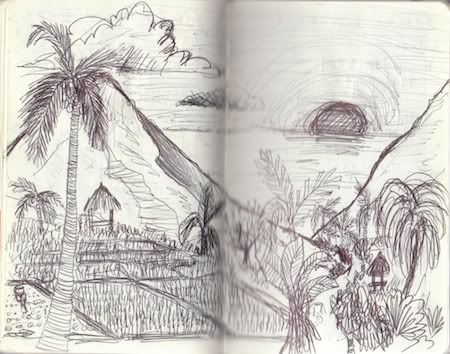 Above, rice paddies in Bali.
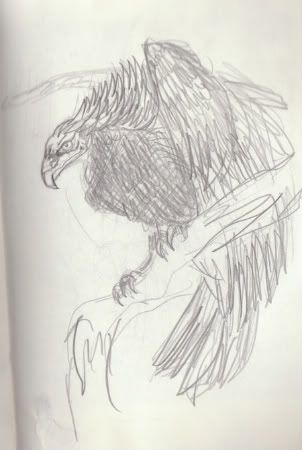 Above, an eagle from a painting in the Indianapolis Museum of Art.
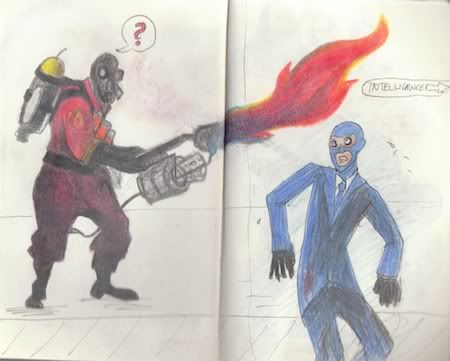
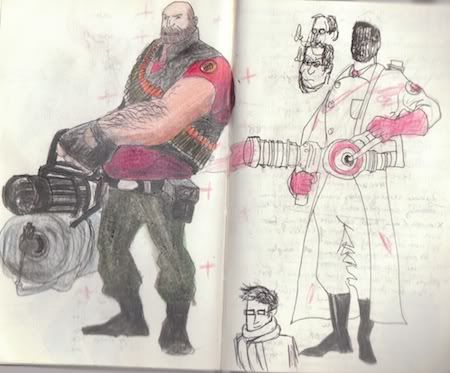 These two above were practice sketches of Team Fortress 2 characters. I eventually drew a birthday card featuring the Pyro lighting the candles on a Portal cake.
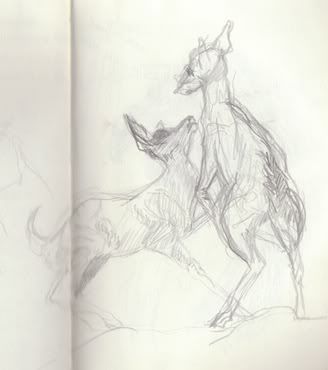 Above, a sculpture of two deer in the Indianapolis Museum of Art.
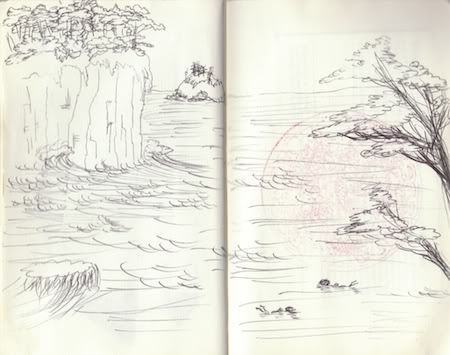 I sketched these above at a seaside restaurant overlooking cliffs at Jeju Island, South Korea.
 Above, some Korean-style houses.
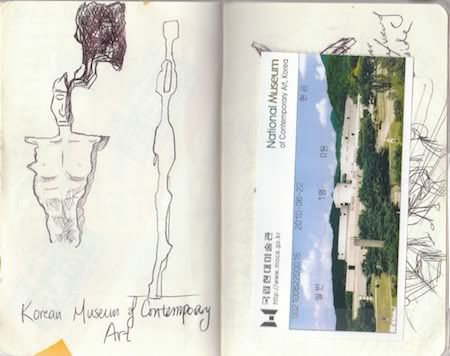
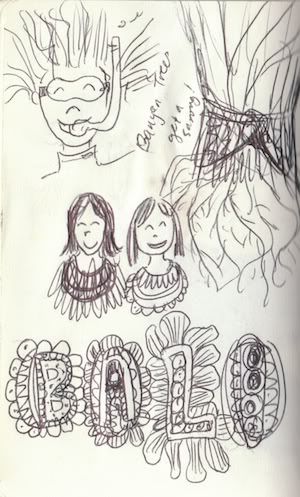 An attempt to do a children's rendition of "What I Did On My Summer Vacation" for Bali.
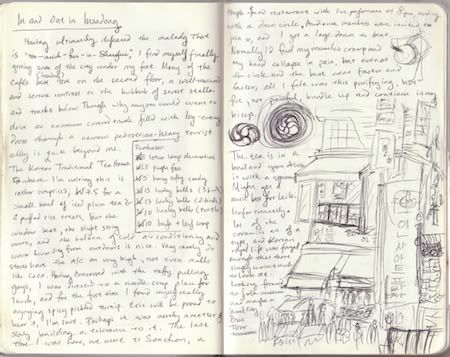 Musings about Insadong.
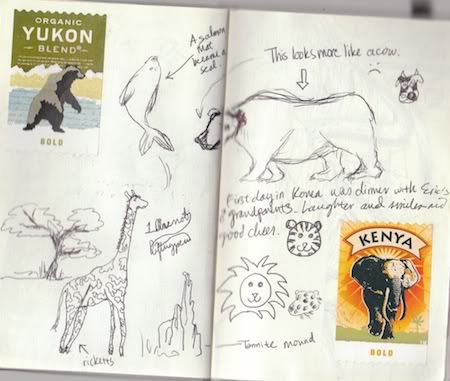

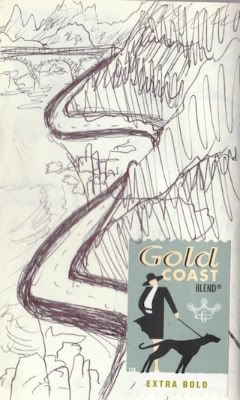
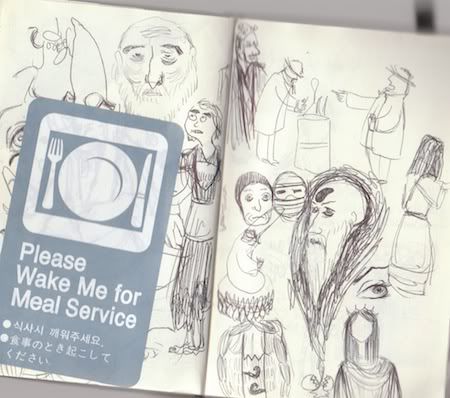 "The Imaginarium of Doctor Parnassus" was playing on the flight to South Korea.
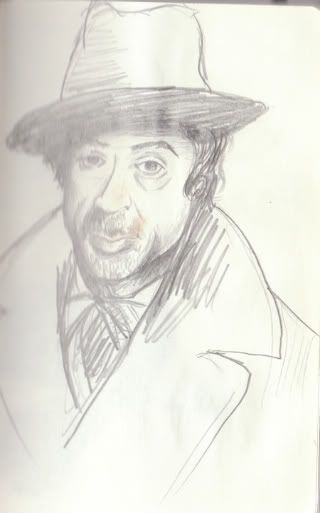 This is 'supposed' to be Robert Downey, Jr. from the film "Sherlock Holmes." I say "supposed to be."
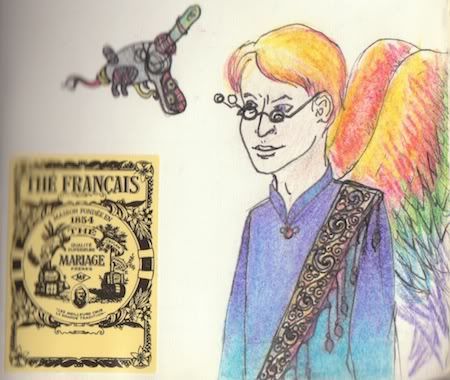
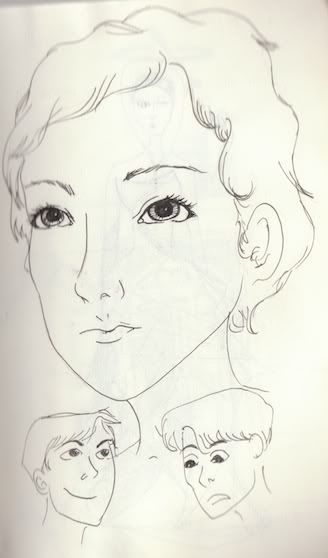 The above boy's head is a riff off of James Jean, I believe.
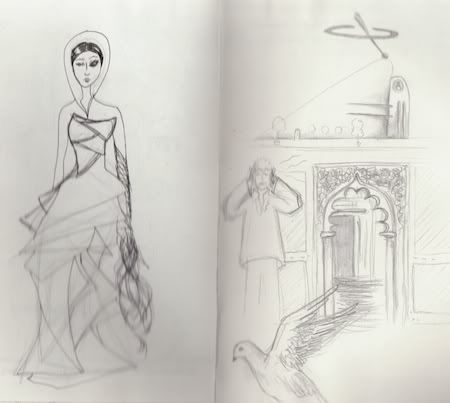






 (Above, some people I saw on the T. I loved the man's nose!)
 (Above, James Hacker, portrayed by Paul Eddington in Yes, Minister)


 (Above, one of my original characters, Adelice Kalani)


 (Above, don't know why this scanned so badly, but it's the Seine.)


 (Above, from JLA Shogun of Steel)
 (Above, from
  (Above, from

 (Above left, Doctor Who in Charles Schulz style. Above right, from Nextwave)
 (Above left, from

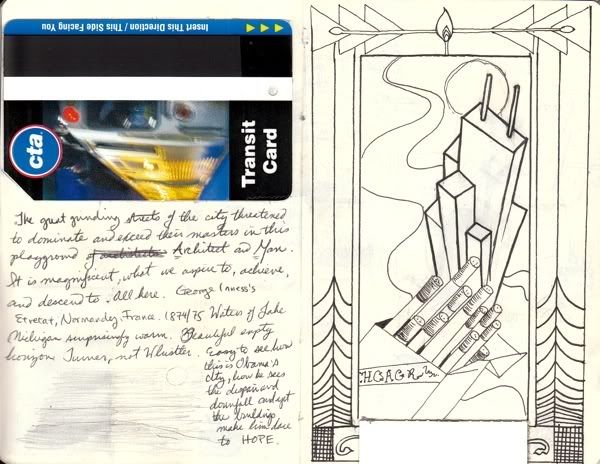
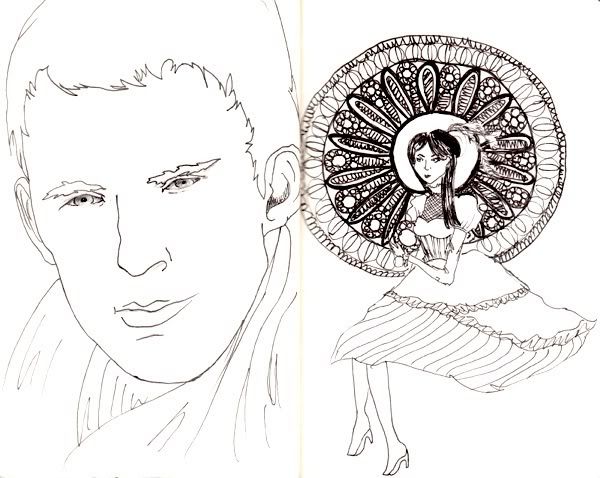
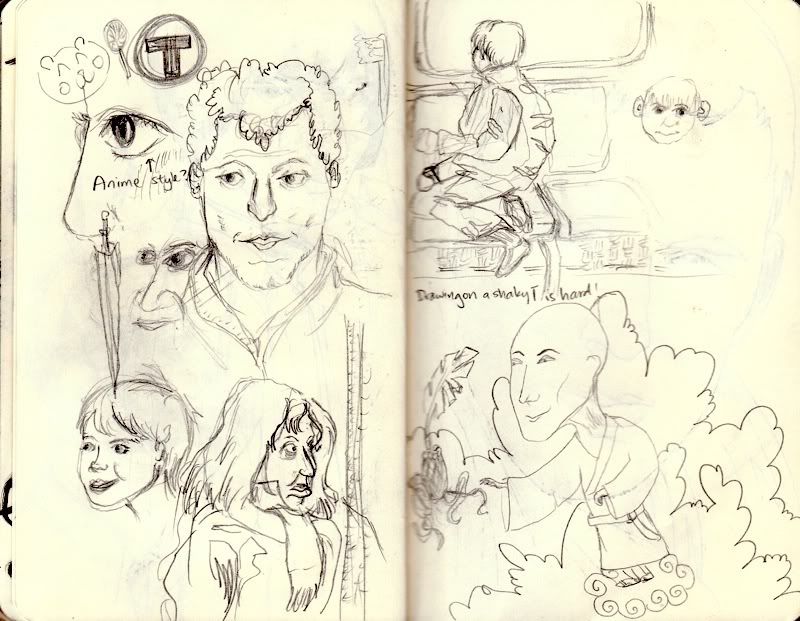
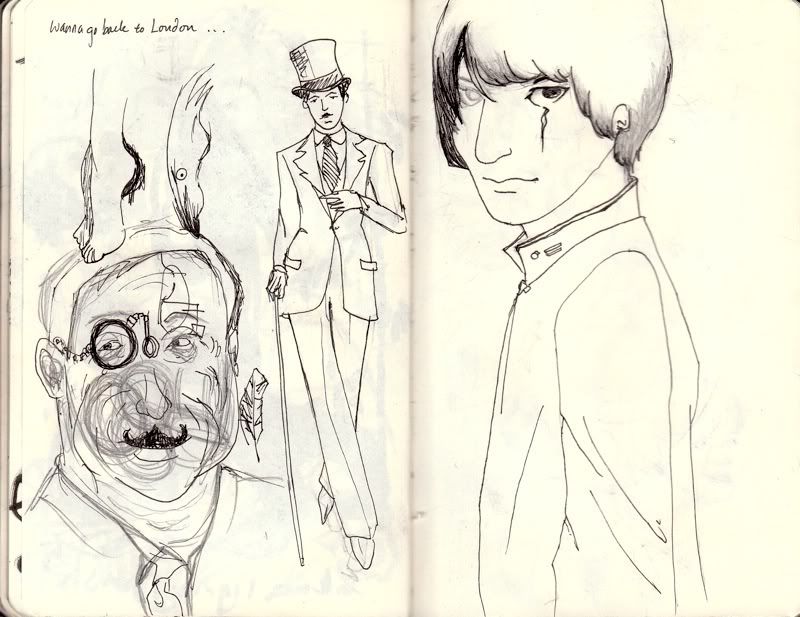 Individual on the right is from another deviantart.com user's work, but I can't find it now. If you recognize it, please let me know and I will provide proper attribution.
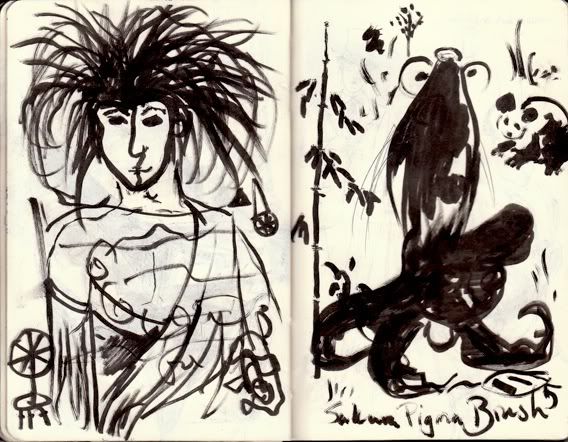 The lack of brush control in the ink Sakura Pigma Brush means I'm only ever going to use it for shading/inking. I much prefer my sumi brushes for actual painting work. Dur.
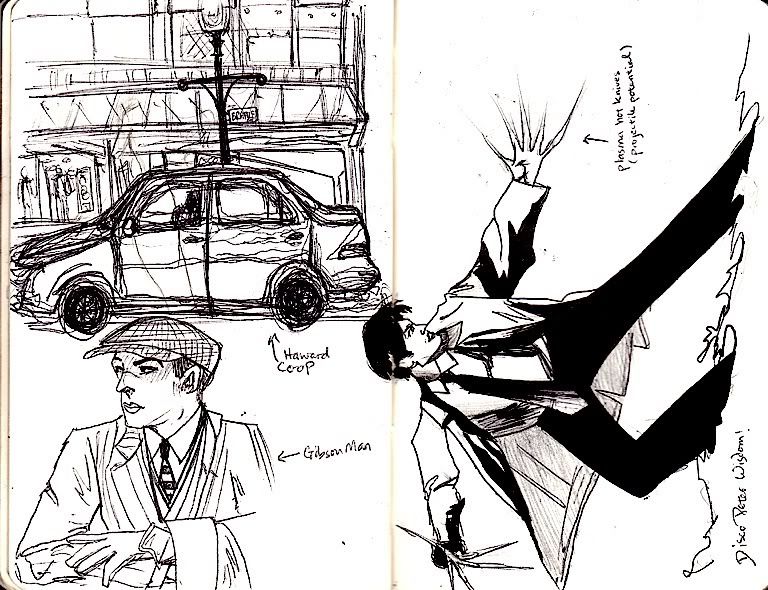 It's starting to get hard to keep up, and to think of things to draw that aren't completely ridiculous. Whenever you see a comic book character, it means I'm being lazy.